Certificates that back our food-safety & quality claims.
Beyond company-level registrations, our team holds individual training certifications across HACCP, ISO management systems, and Good Practice (GxP) modules. Each certificate below can be opened for a full-size view, and includes the category-specific relevance buyers usually ask about.
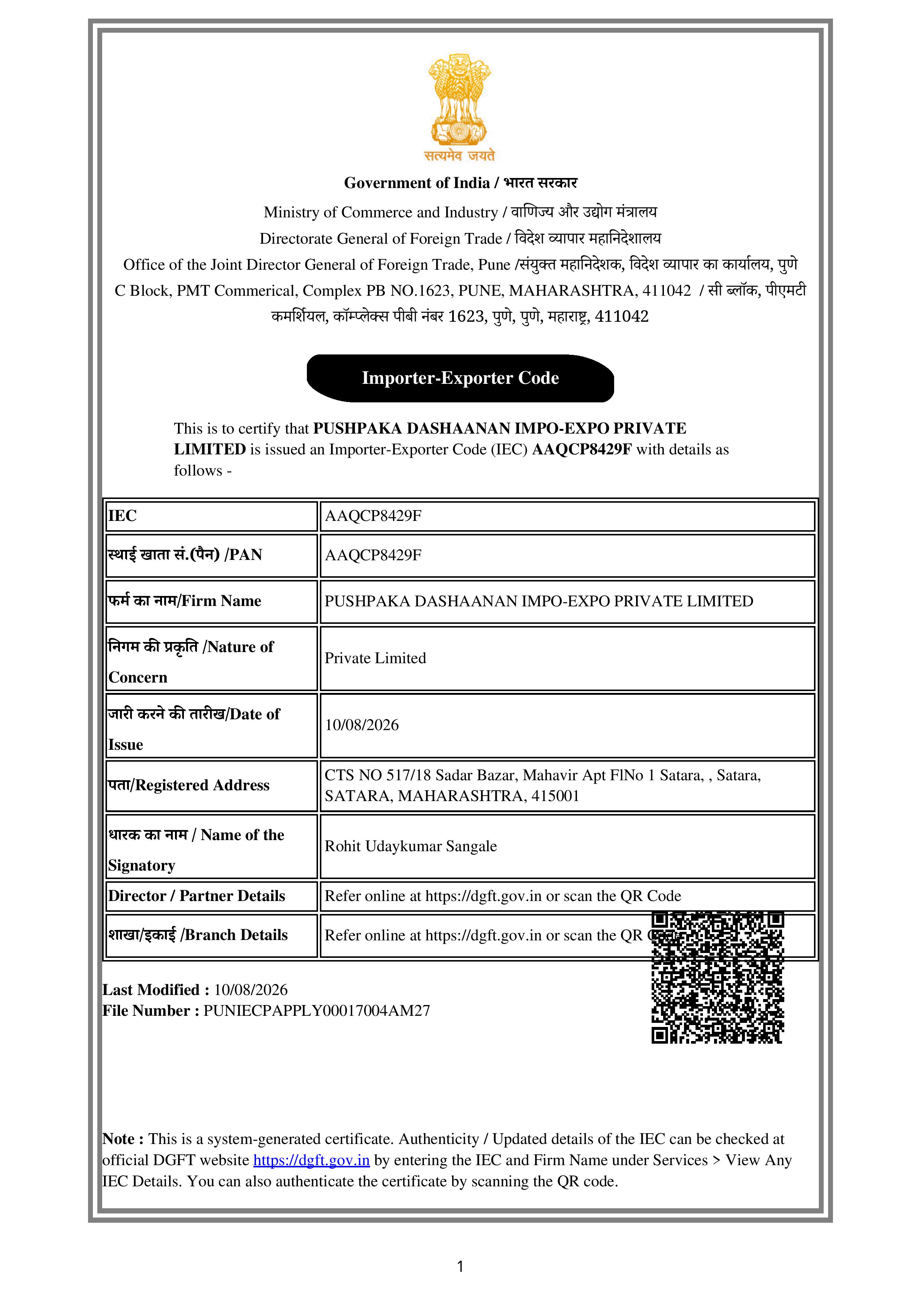
Importer-Exporter Code (IEC) Certificate
Mandatory business identification number issued by the Directorate General of Foreign Trade for undertaking import and export activity from India. The IEC is the primary registration referenced on shipping bills, customs filings and banking documents for every export consignment.
Category relevance ▾
All Export Categories
Enables legal export clearance across spices, pulses, dry fruits, agro products, meat, industrial commodities and handicrafts.
Customs & Documentation
Quoted on shipping bills, e-BRC, and customs declarations, allowing shipments to be filed and cleared without third-party intermediaries.
Banking & Remittance
Required by authorised dealer banks to process inward remittance and export proceeds against international orders.

Quality Assurance Laboratory Testing for Food Industry
One-day professional course covering chemical and microbiological laboratory testing methods used to assess food safety and quality prior to dispatch.
Category relevance ▾
Meat
Supports quality assurance through chemical and microbiological laboratory testing of food products, helping assess safety and quality.
Spices
Supports chemical and microbiological testing for quality, safety, contamination and compliance-related laboratory assessment.
Pulses & Legumes
Supports laboratory testing and quality assurance through chemical and microbiological analysis of food samples.
Dry Fruits & Edible Nuts
Supports chemical and microbiological testing to evaluate food safety, quality and potential contamination.
Agro Products
Supports quality assurance through appropriate chemical and microbiological laboratory testing of edible agricultural products.

ISO 22000:2018 Food Safety Management System
Training on the structure and application of a documented food safety management system spanning hazard control, monitoring, verification and continual improvement.
Category relevance ▾
Meat
Supports a structured food safety management system for meat and seafood operations, including hazard control, documented processes, monitoring, communication and continual improvement.
Spices
Supports systematic food-safety management for spice processing, including risk control, documented procedures, monitoring, verification and continual improvement.
Pulses & Legumes
Supports an organized food-safety management system covering risk assessment, processing controls, hygiene, documentation and continual improvement for pulses and legumes.
Dry Fruits & Edible Nuts
Supports systematic management of food-safety risks, hygiene controls, storage conditions, documentation and continual improvement for dry fruits and edible nuts.
Agro Products
Supports a structured food-safety management framework for agro-product operations through risk-based controls, documented procedures and continual improvement.

ISO 9001:2015 Quality Management System
Course covering ISO 9001:2015 quality-management principles — process control, documentation discipline and continual improvement in commercial operations.
Category relevance ▾
Meat
Supports ISO 9001:2015 quality management practices, process control, documentation and continual improvement in meat and seafood operations.
Spices
Supports standardized quality-management procedures, process consistency, documentation and continual improvement for spices.
Pulses & Legumes
Supports quality planning, controlled processes, documentation and continual improvement for pulses and legumes.
Dry Fruits & Edible Nuts
Supports standardized quality-management practices, process control, documentation and consistent quality improvement for dry fruits and edible nuts.
Agro Products
Supports implementation of ISO 9001:2015 quality-management principles, controlled processes, documentation and continual improvement for agro products.

Good Manufacturing Practices (GMP) — Level 1
Covers hygienic handling, controlled processing and contamination-prevention practices required for consistent food-safety discipline in manufacturing.
Category relevance ▾
Meat
Supports good manufacturing practices covering hygienic handling, controlled processing, contamination prevention and consistent food-safety practices.
Spices
Supports hygienic manufacturing, controlled processing, prevention of contamination and consistent quality practices.
Pulses & Legumes
Supports hygienic handling, processing, storage and quality-control practices throughout food manufacturing operations.
Dry Fruits & Edible Nuts
Supports hygienic processing, handling, storage and contamination-control practices for food products.
Agro Products
Supports good manufacturing and hygiene practices during processing, handling, packaging and storage of edible agricultural products.

Good Production & Processing Practices (GPPP) — Level 1
Covers hygienic production, controlled processing, contamination prevention and consistent handling & storage discipline across food commodities.
Category relevance ▾
Meat
Supports good production and processing practices, hygienic handling, contamination prevention, controlled processing and safe food production.
Spices
Supports hygienic production, proper processing, contamination control and consistent food-safety practices.
Pulses & Legumes
Supports good production, processing, handling, storage and hygiene practices for food commodities.
Dry Fruits & Edible Nuts
Supports hygienic production and processing, contamination prevention, proper handling and storage of food products.
Agro Products
Supports good production and processing practices during handling, processing, packaging and storage of edible agricultural products.

Good Documentation Practices (GDP) — Level 1
Covers accurate, traceable record-keeping practices — from raw-material receipt through processing, testing and dispatch documentation.
Category relevance ▾
Meat
Supports accurate and traceable documentation of receiving, storage temperatures, processing, sanitation, inspection and food-safety records for meat and seafood products.
Spices
Supports clear and traceable records for raw materials, batch processing, quality checks, cleaning, storage and release of spice products.
Pulses & Legumes
Supports accurate documentation of procurement, cleaning, grading, processing, storage, testing and traceability records for pulses and legumes.
Dry Fruits & Edible Nuts
Supports complete and traceable records for sourcing, inspection, allergen-related controls, processing, storage and quality checks of dry fruits and edible nuts.
Agro Products
Supports accurate, consistent and traceable documentation for agricultural product handling, processing, packaging, storage, inspection and quality records.

Hazard Analysis & Critical Control Points (HACCP) — Level 3
Advanced Level 3 hazard-analysis training delivered by SGS India, covering critical control point identification, monitoring and preventive food-safety controls.
Category relevance ▾
Meat
Directly relevant. The certificate covers workers involved in slaughtering, cutting, processing, transformation and sale of meat, fish and molluscs.
Spices
Relevant as a food-safety training credential supporting hygienic food handling and compliance with food-safety requirements; the certificate does not specifically name spices.
Pulses & Legumes
Relevant to food-safety handling and hygiene practices; pulses and legumes are not specifically listed in the certificate's role categories.
Dry Fruits & Edible Nuts
Relevant to food-safety handling and hygiene practices; dry fruits and nuts are not specifically listed in the certificate.
Agro Products
Relevant to general food-safety practices, but the certificate specifically lists certain food-handling roles rather than these products.

Corso HACCP Accreditato per Alimentaristi
Companion online course to the Bologna HACCP base training, reinforcing food-handler hazard-control fundamentals under HACCP principles for food personnel.
Category relevance ▾
Meat
Supports hazard analysis and critical control point practices for safe handling, processing and contamination control of meat and seafood.
Spices
Supports identification and control of food-safety hazards during handling, processing and storage of spices.
Pulses & Legumes
Supports food-safety hazard control, hygienic handling, storage monitoring and preventive controls for pulses and legumes.
Dry Fruits & Edible Nuts
Supports hazard prevention, contamination control, safe handling and storage practices for dry fruits and edible nuts.
Agro Products
Supports HACCP-based food-safety practices, hazard control, monitoring and preventive measures for agricultural food products.